Many people remember biking as something that once felt effortless. You got on, started pedaling, and went wherever the road or trail led.
Then life changed.
The bike spent more time in the garage. Work, family, injuries, traffic, or other priorities got in the way. Years passed, and an activity that once felt natural began to feel unfamiliar.
The desire to ride may still be there. So may the hesitation.
The good news is that you do not have to return as the rider you once were—or become the kind of cyclist you see flying past in expensive gear.
You only need to begin where you are now.
Start With the Ride, Not the Equipment
Cycling can appear more complicated than it needs to be. There are road bikes, mountain bikes, hybrids, electric bikes, specialized clothing, computers, shoes, and countless accessories.
Some of those may eventually improve the experience. None of them needs to be the starting point.
The first question is much more basic:
Do you have access to a bike that feels comfortable, fits reasonably well, and works safely?
A bike shop can inspect an older bike, adjust the seat, check the brakes and tires, and tell you whether it is ready to ride.
Renting or borrowing a bike may also help you learn what feels comfortable before buying anything.
Do not let the search for the perfect bike keep you from taking the first ride.
Perfect equipment matters far less than feeling stable and confident.
Choose an Easy Place to Begin
The route can shape the entire experience.
A busy street, steep climb, or crowded trail may confirm every concern you had before starting.
Instead, choose a place where you can focus on riding rather than managing constant obstacles.
A paved recreational trail, quiet neighborhood, park loop, or wide bike path can be a good place to begin. Look for a relatively flat route with few intersections and an easy place to turn around.
The first ride does not need to cover much distance. Twenty relaxed minutes may be enough to reacquaint yourself with balancing, braking, shifting, and getting comfortable in the seat.
The purpose is not to see how far you can go. It is to finish thinking, “I could do that again.”
Expect the First Ride to Feel Unfamiliar
The phrase “just like riding a bike” suggests that everything will immediately come back.
The basic motion probably will. Comfort may take longer.
The seat may feel strange. Your legs may tire sooner than expected. Turning, shifting, or starting again after a stop may require more attention than you remember.
That is not failure.
It is simply what happens when the body and mind return to an activity after time away.
Give yourself a few rides before judging the experience.
The second ride will usually feel easier than the first because you are no longer figuring out everything at once. By the third or fourth, you may begin paying less attention to the mechanics and more attention to where the ride is taking you.
Familiarity returns through repetition.
Ride at Your Current Pace
Comparison can quickly remove the enjoyment from biking. Other riders may be faster, cover more miles, or climb hills that currently feel unrealistic.
Their ride has nothing to do with yours.
A comfortable pace allows you to stay aware of your surroundings, control the bike, and finish without feeling depleted. You should be able to slow down, stop when needed, and take breaks without treating them as evidence that you do not belong.
Speed is not what makes someone a cyclist. Riding a bike does.
Your pace may increase naturally as your confidence and endurance return. There is no need to force the process.
Make Safety Part of Feeling Confident
Confidence does not come from pretending there are no risks. It comes from reducing the risks you can control.
- Wear a properly fitted helmet.
- Check your tires and brakes before riding.
- Bring water, identification, and a phone.
- Choose visible clothing.
- Use lights when conditions call for them.
Learn the route before leaving, especially if it involves streets or unfamiliar intersections.
It also helps to practice a few basics in a quiet area:
- Starting and stopping smoothly
- Looking behind you without swerving
- Shifting before a hill
- Braking gradually with both brakes
- Signaling before turning
These skills may return quickly, but practicing them away from traffic gives you room to rebuild confidence.
Riding With Others Can Make It Easier
A riding partner can provide encouragement, route knowledge, and help if something goes wrong. But choose the right person.
Your first rides back should not be with someone who treats every outing like a race or makes you feel apologetic for your pace.
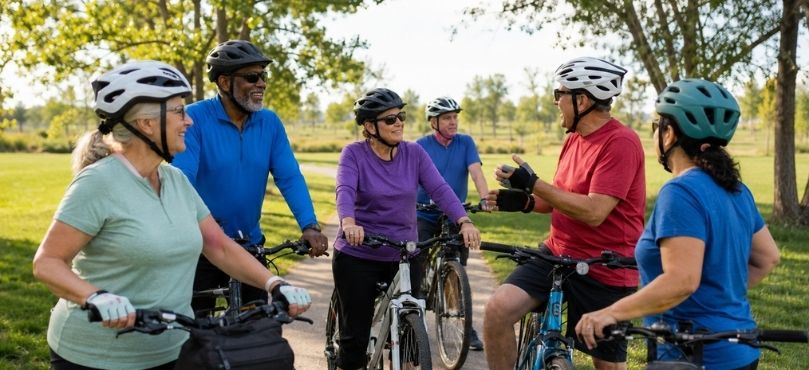
Look for a friend or group that clearly welcomes newer or returning riders. Terms such as “easy pace,” “beginner-friendly,” or “no-drop” generally signal that the group intends to stay together rather than leave slower riders behind.
Before joining, check the expected distance, terrain, pace, and type of bike recommended.
A supportive group can make riding feel more social and less intimidating. The wrong group can make a perfectly capable rider feel as though they are failing.
Choose carefully.
Give the Ride Somewhere to Go
Exercise alone may not be enough motivation to keep returning. A destination can make the experience more appealing.
Ride to a coffee shop, park, farmers market, overlook, or place you have wanted to explore. Meet someone along the route. Choose a trail with scenery or a neighborhood you enjoy.
The bike becomes more than exercise.
It becomes transportation, recreation, and a way to experience familiar places differently.
That sense of movement and discovery is part of what makes cycling memorable. You are not only completing miles. You are going somewhere.
Build Gradually
The temptation after a good first ride is to do too much on the next one.
A little soreness is normal when returning to an activity, but dramatically increasing distance or difficulty can make the experience less enjoyable and delay your next ride.
Add time, hills, or distance gradually.
Keep some rides easy even after you begin feeling stronger.
Consistency is more valuable than proving how much you can handle in a single outing.
A modest ride every week can become part of your life.
One exhausting ride may send the bike back into storage.
A Question to Ask Yourself
What would make getting back on a bike feel easy enough to begin?
Maybe it is having your old bike checked.
Maybe it is renting one before deciding what to buy.
Maybe it is choosing a flat trail, inviting a patient friend, or finding an easy-paced group ride.
Remove one obstacle and schedule one short outing.
You do not need to recover every mile you have missed.
You only need to ride the first one.